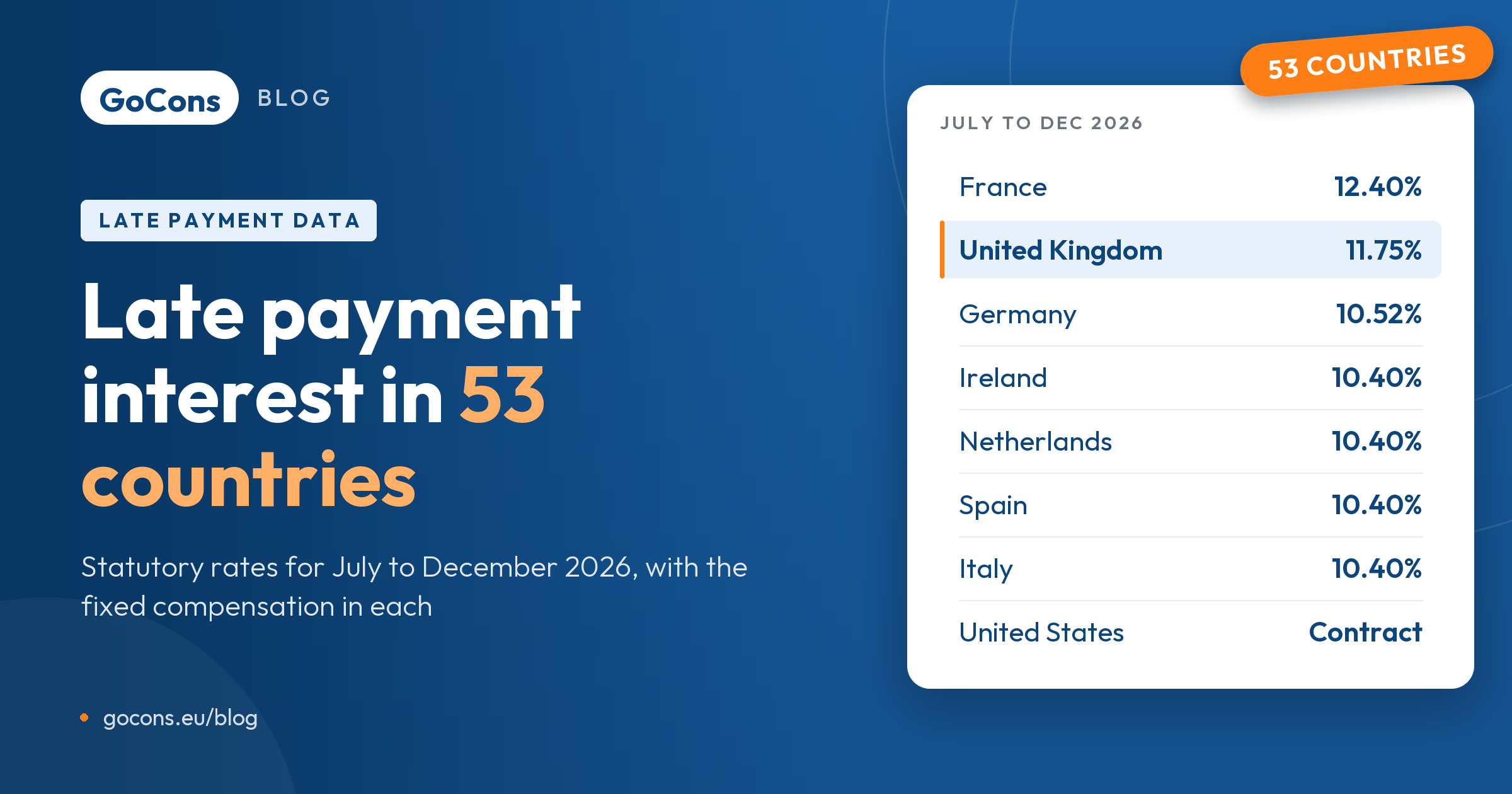
When a business client pays an invoice late, the law of most countries lets you add interest and, in many of them, a fixed sum for each late invoice. The rate is not the same everywhere, and in most of Europe it changes twice a year. This page lists the statutory rate in each of the 53 countries in the GoCons late payment interest calculator for 1 July to 31 December 2026, how each country sets it, and the compensation it adds.
Every figure was checked against an official source between 24 and 26 October 2026: the law itself, the central bank that publishes the reference rate, or the government notice that publishes the rate. That mattered more than expected. The European Commission's Your Europe table is a good starting point, but in late October it still showed the first-half rate of 10.15% for Italy and the Netherlands, where the rate since 1 July is 10.40% [1][2][3]. The calculator uses the same tables as this page, so each country name below opens it with that country's law already chosen.
Which country's rate applies to your invoice
The rate of the law that governs the contract, which is not necessarily your client's country. Most contracts name that law. When yours does not, a contract for services between parties in the EU is governed by the law of the country where the service provider has its habitual residence [4]: for a consultant, usually their own country. A Portuguese consultancy invoicing a German client under a contract that is silent on the law would therefore claim Portuguese late-payment interest, not German.
How to read the tables
- Rate a year is simple interest on the unpaid amount, unless the table says it is compounded. Where it is built on a reference rate, the reference used for July to December 2026 is in brackets.
- Contract means the country sets no statutory rate between businesses: you charge the rate your contract sets, and without one, interest depends on a court.
- Fixed compensation is owed for each late invoice on top of the interest, in the local currency. "At least" means reasonable recovery costs above it, such as a collection agency's fee, can be claimed too. In the EU the minimum is €40, due without a reminder [5].
The European Union
The EU Late Payment Directive sets the floor: the reference rate plus at least 8 percentage points, the rate in force on 1 January for the first half of the year and on 1 July for the second [5]. In the euro area the reference is the European Central Bank's main refinancing rate, which was 2.40% on 1 July 2026 [6]; countries with their own currency use their central bank's rate.
| Country | Rate a year | How it is set | Fixed compensation per late invoice |
|---|---|---|---|
| Austria | 10.73% | OeNB base rate (1.53%) + 9.2 points | €40, at least |
| Belgium | 10.50% | ECB rate (2.40%) + 8 points, rounded up to the next half point | €40, at least |
| Bulgaria | 10.40% | ECB rate (2.40%) + 8 points, since the euro in January 2026 | €40, at least |
| Croatia | 10.40% | ECB rate (2.40%) + 8 points | €40, at least |
| Cyprus | 10.40% | ECB rate (2.40%) + 8 points | €40, at least |
| Czechia | 11.75% | Czech National Bank repo rate (3.75%) + 8 points, fixed for the whole delay when interest starts | CZK 1,200, at least |
| Denmark | 10.00% | Nationalbanken lending rate (2.00%) + 8 points | DKK 310 |
| Estonia | 10.40% | ECB rate (2.40%) + 8 points | €40, at least |
| Finland | 10.50% | Bank of Finland reference rate (2.50%) + 8 points | €40 |
| France | 12.40% | ECB rate (2.40%) + 10 points, unless the contract sets another rate | €40, at least |
| Germany | 10.52% | Bundesbank base rate (1.52%) + 9 points | €40, at least |
| Greece | 10.40% | ECB rate (2.40%) + 8 points | €40, at least |
| Hungary | 14.00% | Hungarian National Bank base rate (6.00%) + 8 points | €40 in forints, at least |
| Ireland | 10.40% | ECB rate (2.40%) + 8 points | €40, €70 or €100, by invoice amount |
| Italy | 10.40% | ECB rate (2.40%) + 8 points | €40, at least |
| Latvia | 10.40% | ECB rate (2.40%) + 8 points | €40, at least |
| Luxembourg | 10.40% | ECB rate (2.40%) + 8 points | €40, at least |
| Malta | 10.40% | ECB rate (2.40%) + 8 points | €40, at least |
| Netherlands | 10.40% | ECB rate (2.40%) + 8 points, compounded yearly | Statutory scale: 15% of the first €2,500, falling to 0.5%; €40 to €6,775 |
| Poland | 13.75% | National Bank of Poland reference rate (3.75%) + 10 points | €40, €70 or €100 in złoty, by amount |
| Portugal | 10.40% | ECB rate (2.40%) + 8 points | €40, at least |
| Romania | 14.50% | National Bank of Romania policy rate (6.50%) + 8 points | €40 in lei, at least |
| Slovakia | 10.40% | ECB rate (2.40%) + 8 points (the default method) | €40, at least |
| Slovenia | 10.40% | ECB rate (2.40%) + 8 points | €40, at least |
| Spain | 10.40% | ECB rate (2.40%) + 8 points | €40, at least |
| Sweden | 10.00% | Riksbank reference rate (2.00%) + 8 points | SEK 450 |
Lithuania is the one EU country not in the calculator yet. We could not read its law in the official register when we checked, and we do not publish a rate we have not verified; under the Directive it is at least the ECB rate plus 8 points. In Austria the rate is 4% when the client proves the delay was not their fault, and in Slovakia the creditor can choose the ECB rate on the first day of the delay plus 9 points, kept for the whole delay.
The rest of Europe
| Country | Rate a year | How it is set | Fixed compensation per late invoice |
|---|---|---|---|
| Albania | 10.50% | Bank of Albania base rate (2.50%) + 8 points | ALL 5,000, at least |
| Bosnia and Herzegovina | Contract | Your contract's rate; each part of the country sets its own default interest (10% a year in the Federation) | None |
| Iceland | 16.75% (Sep to Nov) | Central Bank of Iceland base (8.75%) + 8 points, set every month, compounded yearly | ISK 6,700, at least |
| Kosovo | 8.00% | 8% a year, fixed by law | None |
| Liechtenstein | 8.25% | Swiss National Bank special rate (0.25%) + 8 points | CHF 60, at least |
| Moldova | 16.00% | National Bank of Moldova base rate (7.00%) + 9 points | €40 in lei |
| Montenegro | 10.40% | ECB rate (2.40%) + 8 points | Not confirmed |
| Norway | 12.25% | Norges Bank policy rate (4.25%) + 8 points | NOK 430 |
| Serbia | 13.75% | National Bank of Serbia key policy rate (5.75%) + 8 points, for debts in dinars | RSD 20,000, at least |
| Switzerland | 5.00% | 5% a year, fixed by law | None; proven costs only |
| Turkey | 43.00% (all of 2026) | Set by the Central Bank every January | TRY 2,020, at least |
| Ukraine | 32.00% (since 18 Sep) | Twice the National Bank of Ukraine discount rate (16.00%), plus 3% a year and inflation | None |
| United Kingdom | 11.75% | Bank of England base rate on 30 June (3.75%) + 8 points, fixed for the whole delay when interest starts | £40, £70 or £100, by amount |
Iceland's rate changes every month; the one shown applies from September to November 2026. In Ukraine the 32% applies since 18 September 2026, and the Civil Code adds 3% a year and the loss from inflation on top. Serbia's rate is for debts in dinars, and it changes with each decision of its central bank. Turkey's rate and minimum compensation are announced every January for the whole year.
The Americas
| Country | Rate a year | How it is set | Fixed compensation per late invoice |
|---|---|---|---|
| Brazil | Contract | Your contract's rate; without one, inflation (IPCA) plus the legal rate published monthly | None |
| Canada | Contract | Your contract's rate; in Quebec, 5% a year after a formal demand | None |
| Mexico | 6.00% | 6% a year, fixed by law | None |
| United States | Contract | Your contract's rate; state law decides without one (Texas 6%, California 10%, New York 9%) | None |
Asia and the Pacific
| Country | Rate a year | How it is set | Fixed compensation per late invoice |
|---|---|---|---|
| Australia | Contract | Your contract's rate; courts may add interest, such as the cash rate + 4% | None |
| China | Contract | Your contract's rate; courts measure the loss on the one-year Loan Prime Rate | None |
| India | 17.25% (since 7 Oct) | Three times the RBI Bank Rate (5.75%), compounded monthly, for registered micro and small suppliers | None |
| Indonesia | Contract | Your contract's rate; statutory interest only from a court claim | None |
| Japan | 3.00% | 3% a year until March 2029, fixed for the whole delay when interest starts | None |
| New Zealand | Contract | Your contract's rate; courts must award interest if you sue | None |
| Pakistan | Contract | Your contract's rate; what courts enforce is uncertain | None |
India's rate under the MSMED Act applies only when the supplier is a micro or small enterprise registered under it; it changed to 17.25% on 7 October 2026, when the Bank Rate moved. Japan reviews its statutory rate every three years and fixed it at 3% from April 2026 to March 2029.
The Middle East and Africa
| Country | Rate a year | How it is set | Fixed compensation per late invoice |
|---|---|---|---|
| Egypt | 5.00% | 5% a year on commercial debts, fixed by law | None |
| Saudi Arabia | None | No interest; only compensation for proven harm | None |
| United Arab Emirates | Contract | Your contract's rate; courts apply a market rate of at most 9% | None |
What changed since the first half of 2026
- Most of the euro area: up 0.25 points. The ECB rate went from 2.15% on 1 January to 2.40% on 1 July, so the common rate went from 10.15% to 10.40%, France from 12.15% to 12.40% and Germany from 10.27% to 10.52% [6][7][8].
- Unchanged: the United Kingdom at 11.75%, with the Bank of England base rate at 3.75% on both 31 December and 30 June [9]; Belgium and Finland at 10.50%, because both round the reference rate up to the next half point; Austria at 10.73%; Sweden at 10.00%; Romania at 14.50%.
- Up: Czechia from 11.50% to 11.75%, Denmark from 9.75% to 10.00%, Norway from 12.00% to 12.25%, Moldova from 14.00% to 16.00%, and Iceland, Ukraine and India during the half-year.
- Down: Poland from 14.00% to 13.75%, Hungary from 14.50% to 14.00% and Liechtenstein from 8.50% to 8.25%. Turkey's 43% for 2026 is down from 53.25% in 2025.
One late invoice, five countries
The same €5,000 invoice (£5,000 in the UK), due on 31 August 2026 and paid on 30 October 2026, 60 days late:
| Law of the contract | Rate | Interest | Compensation | Total claim |
|---|---|---|---|---|
| Germany | 10.52% | €86.47 | €40.00 | €126.47 |
| Ireland | 10.40% | €85.48 | €70.00 | €155.48 |
| United Kingdom | 11.75% | £96.58 | £70.00 | £166.58 |
| France | 12.40% | €101.92 | €40.00 | €141.92 |
| Netherlands | 10.40% | €85.48 | €625.00 | €710.48 |
Interest is the amount × the rate × 60 days ÷ 365. The interest barely moves from one country to the next; the compensation is what changes the claim. The Netherlands stands out because its collection costs follow a statutory percentage scale rather than a flat sum (between businesses, a contract can set other amounts). Each country name opens that example in the calculator.
Would you rather not get to the claim letter? GoCons keeps each invoice with its contract, reminds your client before it falls due and shows you both the day it is late. Free to start, no card needed.
Working it out for your own invoices
Choose the country whose law governs the contract in the late payment interest calculator, then enter each late invoice with its amount, due date and the date it was paid (leave that empty if it is still unpaid, and interest runs to today). The calculator applies that country's rule: each half-year's rate for the days in it across most of the EU, or the rate fixed when interest started in the United Kingdom, Czechia and Japan. It adds the compensation, and it writes a claim letter you can print or copy, citing the law. For the countries without a statutory rate it asks for the rate in your contract.
Nothing you type leaves your browser. "Copy a link to this result" gives you a link with the amounts and dates only, never names or invoice numbers, so you can send the calculation to a colleague or keep it with the file.
Where GoCons fits
The calculator tells you what an invoice is owed once it is late. GoCons is for the weeks before that. You attach each invoice to its period in the contract's billing schedule, and your client's users get a notice when it is issued and another three days before it falls due; the day after the due date, the line turns Overdue for both of you. GoCons does not issue invoices or collect payments: it tracks the ones your own invoicing software issued, in a client portal where clients sign in for free.
FAQ
Why do so many countries have exactly the same rate?
Because the EU Directive sets the rate as the reference rate plus at least 8 points, and the 20 euro countries share one reference rate, the ECB's. Most of them apply the minimum, so most of the euro area is at 10.40% from July to December 2026. France (ECB plus 10), Germany (its base rate plus 9) and Austria (plus 9.2) chose more.
Does the rate change while an invoice is still unpaid?
In most of the EU, yes: the days in each half-year count at that half-year's rate. In the United Kingdom, Czechia and Japan, the rate in force when interest started applies until the debt is paid. The calculator follows the rule of the country you choose and shows the rates it used.
Is the interest charged on the amount with VAT?
In the EU, yes. The Court of Justice ruled in 2022 that the amount due includes the VAT shown on the invoice, and that the €40 is owed for each commercial transaction certified by an invoice [10].
Can my contract set a different rate?
Usually, yes. In the EU, a clause that excludes late-payment interest is grossly unfair, and one that excludes the compensation is presumed to be [5]. In France a contract rate cannot be lower than three times the legal interest rate [7]. In the United Kingdom, a rate agreed in the contract replaces statutory interest [11].
When will the January 2027 rates be here?
Central banks and governments publish them in the first days of each half-year, and the calculator takes each rate as soon as its official source publishes it. Until then it says the rate is not in yet rather than calculate with an old one. This page is updated after each change.
References
- Your Europe, "B2B late payments: interest, penalties and compensation", https://europa.eu/youreurope/business/finance-and-tax/making-receiving-payments/late-payment/index_en.htm (accessed October 2026).
- Gazzetta Ufficiale, "Saggio degli interessi di mora, 1° luglio – 31 dicembre 2026" (16 July 2026), https://www.gazzettaufficiale.it/atto/serie_generale/caricaDettaglioAtto/originario?atto.dataPubblicazioneGazzetta=2026-07-16&atto.codiceRedazionale=26A03514 (accessed October 2026).
- Rijksoverheid, "Hoe hoog is de wettelijke rente?", https://www.rijksoverheid.nl/documenten/vraag-en-antwoord/schulden/hoogte-wettelijke-rente (accessed October 2026).
- Regulation (EC) No 593/2008 on the law applicable to contractual obligations (Rome I), Article 4(1)(b), https://eur-lex.europa.eu/legal-content/EN/TXT/HTML/?uri=CELEX:32008R0593 (accessed October 2026).
- Directive 2011/7/EU on combating late payment in commercial transactions, Articles 2, 3, 6 and 7, https://eur-lex.europa.eu/legal-content/EN/TXT/HTML/?uri=CELEX:32011L0007 (accessed October 2026).
- European Central Bank, "Key ECB interest rates", https://www.ecb.europa.eu/stats/policy_and_exchange_rates/key_ecb_interest_rates/html/index.en.html (accessed October 2026).
- Service-public.fr, "Délais de paiement entre professionnels et pénalités de retard", https://entreprendre.service-public.gouv.fr/vosdroits/F23211 (accessed October 2026).
- Deutsche Bundesbank, "Basiszinssatz", https://www.bundesbank.de/de/bundesbank/organisation/agb-und-regelungen/basiszinssatz-607820 (accessed October 2026).
- Bank of England, "Bank Rate history", https://www.bankofengland.co.uk/boeapps/database/Bank-Rate.asp (accessed October 2026).
- Court of Justice of the European Union, judgment of 20 October 2022, BFF Finance Iberia, C-585/20, https://eur-lex.europa.eu/legal-content/EN/TXT/HTML/?uri=CELEX:62020CJ0585 (accessed October 2026).
- GOV.UK, "Late commercial payments: charging interest and debt recovery", https://www.gov.uk/late-commercial-payments-interest-debt-recovery/charging-interest-commercial-debt (accessed October 2026).
The official sources for every other country are listed in the calculator, under each country's explanation. This is general information, not legal advice.
© 2026 Mourinho Solutions. All rights reserved.