It is Thursday afternoon and the client's procurement lead answers your proposal with one line: "Can you make this a fixed price?" You estimated the data migration at 300 hours, but nobody has opened the source systems yet. Say yes and every surprise in those systems is yours. Say no and the deal may go to a firm that said yes. Time and materials vs fixed price is not a matter of taste: it decides who pays when the estimate turns out to be wrong.
I have made this call in my own consulting work and sat on the buying side at SISTRADE and UNICEF. I also taught operations research and decision theory at the University of Porto for eight years, and this is a textbook decision under uncertainty. So this article works through one project with real arithmetic, then gives you a decision rule and the clauses that protect you.
Time and materials vs fixed price: what each one sells
With time and materials (T&M) you sell hours at an agreed rate, plus expenses, and the client pays for whatever effort the work really takes. US federal procurement rules allow it only when the extent or duration of the work cannot be estimated accurately, and they note that it gives the supplier "no positive profit incentive" to control costs, which is why buyers ask for a ceiling [1].
With a fixed price you sell a defined result for one amount. The same rules describe it as placing on the supplier "maximum risk and full responsibility for all costs and resulting profit or loss" [2]. The World Bank's procurement regulations draw the line the same way for consulting: a lump sum suits work whose scope can be specified clearly and tied to milestones, and time-based contracts suit complex studies and advisory work whose scope and duration are hard to fix [3].
| Time and materials | Fixed price | |
|---|---|---|
| The client buys | Hours at an agreed rate | A defined result for one amount |
| An overrun is paid by | The client | You |
| Budget certainty for the client | Low, unless capped | High |
| Your margin per hour | Fixed | Higher if you beat the estimate, lower if not |
| A scope change needs | A conversation and more hours | A priced change request |
| Works best when | Scope is unclear or the client controls key inputs | Scope and acceptance can be written down |
One project, three contracts: a worked example
Take that 300-hour estimate at EUR 100 an hour (example numbers, chosen to keep the arithmetic readable). Under T&M the client pays EUR 100 for every hour worked. For a fixed price you add a 15% contingency and quote EUR 34,500. A third option many buyers propose is capped T&M: EUR 100 an hour with a ceiling, here EUR 33,000 (330 hours). UK government guidance spells out the catch: if the cap is reached before the work is finished, the supplier completes it at its own cost, and if the work finishes early, the client pays only the time used [4].
| Actual hours | Time and materials | Fixed price EUR 34,500 | Capped T&M, cap EUR 33,000 |
|---|---|---|---|
| 270 (10% under) | EUR 27,000 (EUR 100/h) | EUR 34,500 (EUR 127.78/h) | EUR 27,000 (EUR 100/h) |
| 300 (on estimate) | EUR 30,000 (EUR 100/h) | EUR 34,500 (EUR 115.00/h) | EUR 30,000 (EUR 100/h) |
| 345 (15% over) | EUR 34,500 (EUR 100/h) | EUR 34,500 (EUR 100.00/h) | EUR 33,000 (EUR 95.65/h) |
| 360 (20% over) | EUR 36,000 (EUR 100/h) | EUR 34,500 (EUR 95.83/h) | EUR 33,000 (EUR 91.67/h) |
| 420 (40% over) | EUR 42,000 (EUR 100/h) | EUR 34,500 (EUR 82.14/h) | EUR 33,000 (EUR 78.57/h) |
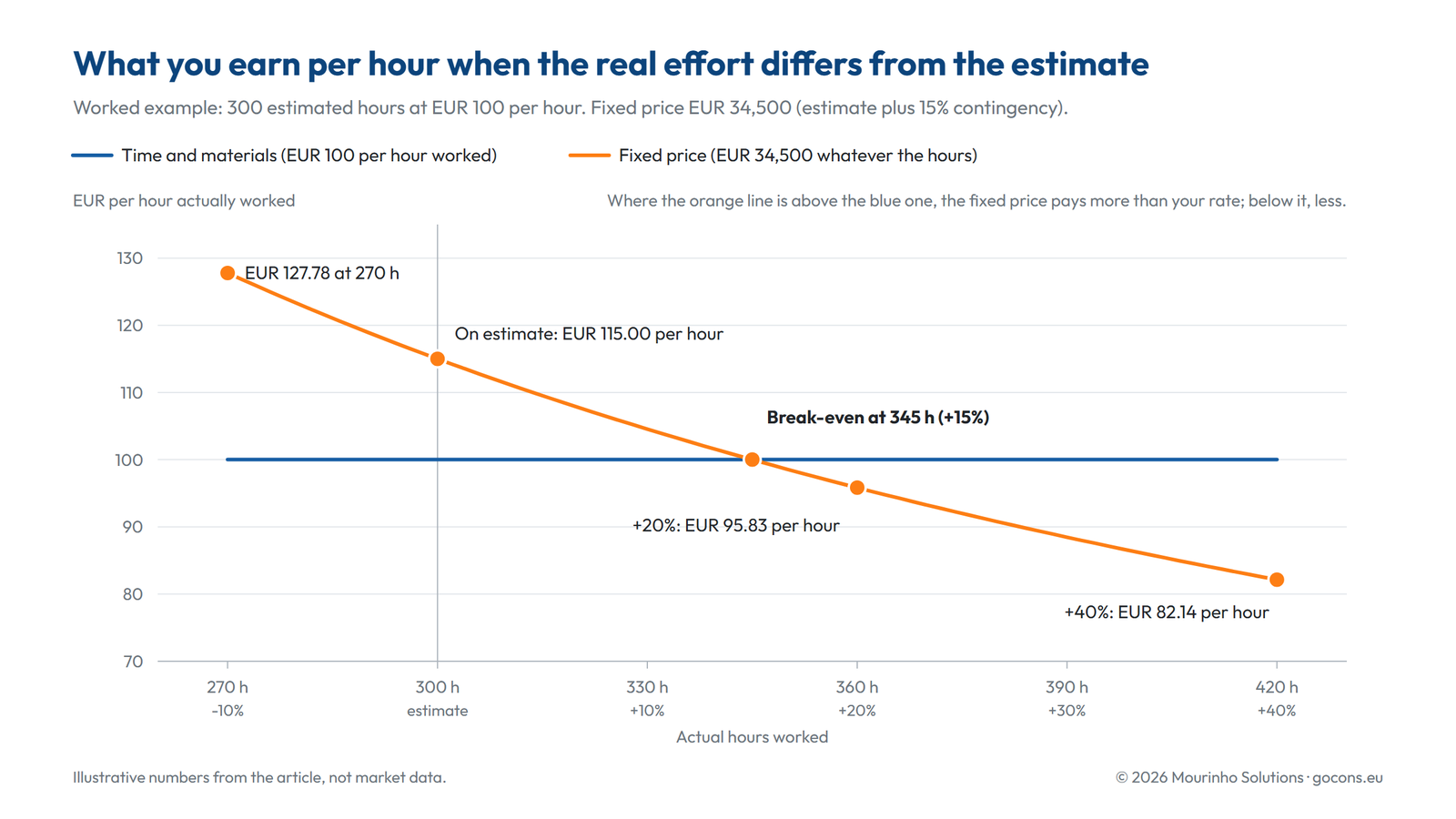
Three things come out of the table. First, the contingency is an insurance premium: you charge the client 15% to carry their estimate risk, and you break even at exactly 15% over. A 20% overrun costs you EUR 1,500 against T&M; a 40% overrun costs EUR 7,500.
Second, a capped T&M at or below the fixed price is never better for you than the fixed price itself: you keep its downside (unpaid hours past the cap) and give away its upside (savings below the estimate go to the client). Accept a cap only with a clause that moves it when the scope moves.
Third, the tail matters more than the average. In Flyvbjerg and Budzier's study of 1,471 IT projects, the average cost overrun was 27%, but one project in six overran by 200% on average [5]. Their sample was IT projects rather than consulting engagements, but the lesson carries: the tail is where a fixed price hurts.
Decision theory adds the last piece. Suppose your history says projects like this finish 10% under 20% of the time, on estimate 40%, 20% over 30% and 40% over 10% (example figures). Expected effort is 324 hours: T&M earns EUR 32,400 on average, the fixed price EUR 34,500. That EUR 2,100 edge comes with a 30% chance of losing EUR 1,500 and a 10% chance of losing EUR 7,500 against T&M. Across ten fixed-price projects a year the swings average out; on one large project, a single bad draw can wipe out a quarter's profit.
A decision rule for your next proposal
- Write the acceptance criteria first. If you cannot write a testable "done" for every deliverable today, do not fix the price yet. Sell a short discovery phase on T&M, then fix the price of what you found.
- Check who controls the inputs. If the client's data, approvals or other suppliers drive the effort, stay on T&M, or list those dependencies as assumptions that reopen the price when they fail.
- Price the contingency from your own actuals. Use the ratio of actual to estimated hours on similar past work. No history means you are guessing, and guessing favors T&M.
- Compare the worst plausible overrun with your cash. If a 40% overrun would hurt more than the contingency helps, choose T&M or split the work into fixed-price phases.
- If the client needs a budget number, offer a phased fixed price or a capped T&M with a re-baseline clause, never a bare cap.
Clauses that protect you in each model
Fixed price
- Written acceptance criteria per deliverable, with deemed acceptance after a set number of business days of silence.
- Assumptions and client dependencies (data delivered by a date, a named decision-maker, access to systems), each one reopening the price if it fails.
- Change control: anything outside the scope is quoted as a change request at your rate card before work starts.
- A limit on review rounds, and payments tied to milestones rather than one invoice at the end.
Time and materials
- A rate card and a definition of billable time, including travel.
- A sentence saying the estimate is an estimate, not a cap.
- A notification threshold: you tell the client when 80% of the estimate is used, with a forecast to finish.
- An hours report every week or month, so the invoice never surprises anyone.
The scope section of a statement of work template is where acceptance criteria and assumptions live, and the change and payment clauses belong in your consulting agreement.
Running either model without month-end surprises
Whichever model you sign, the risk shows up in hours recorded against estimates. A spreadsheet works: one row per task (estimate, hours so far, percentage complete), reviewed every Friday; when hours grow faster than progress, an overrun is coming. What it cannot do is warn you between Fridays, show the client where things stand, or record who moved which date.
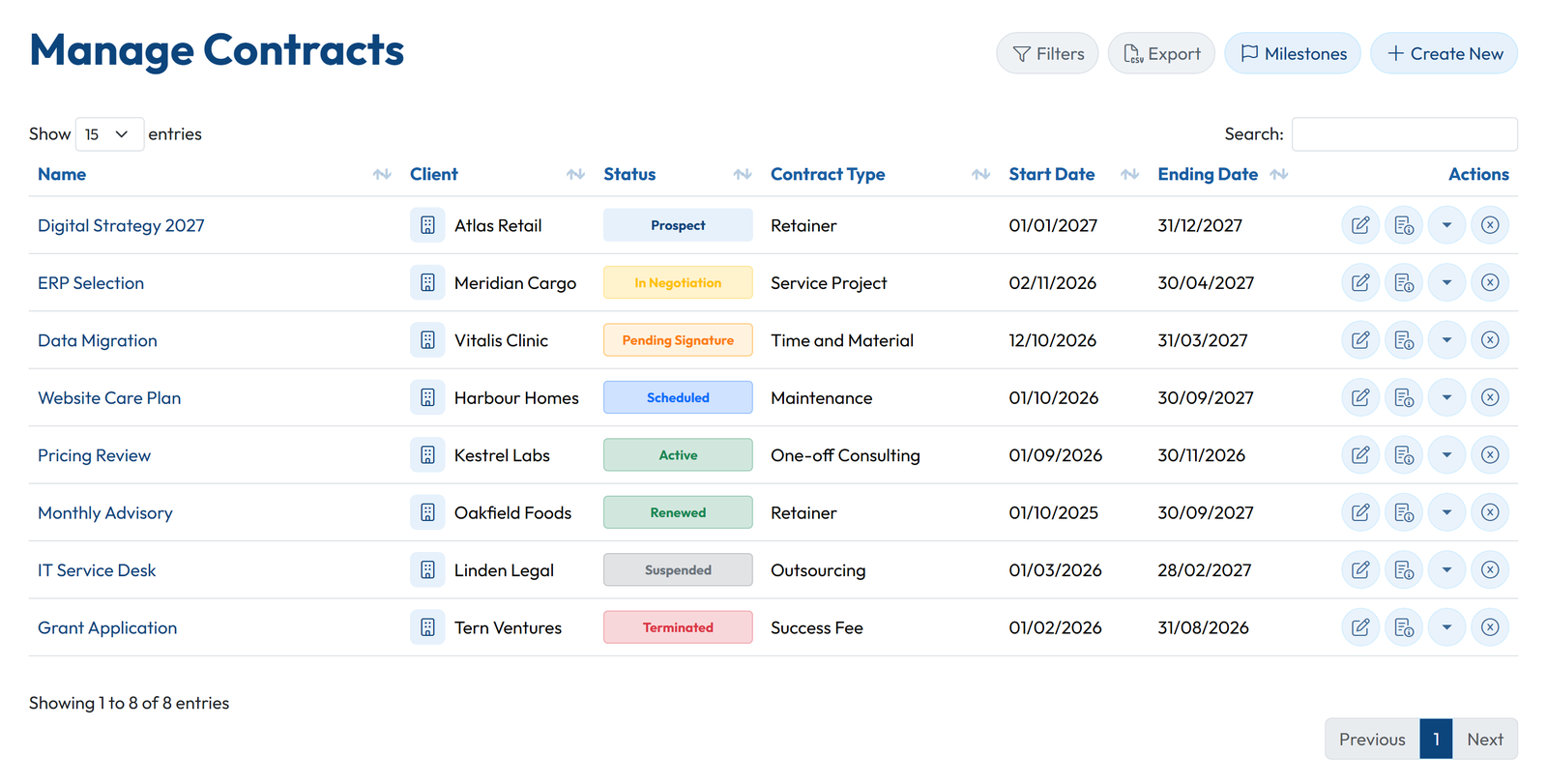
In GoCons, the model is part of the contract from the start: Time and Material carries an hourly rate against estimated hours, and Service Project carries one agreed total, milestone by milestone. They are two of the nine contract types, each with its own billing model, frequency, payment term and currency.
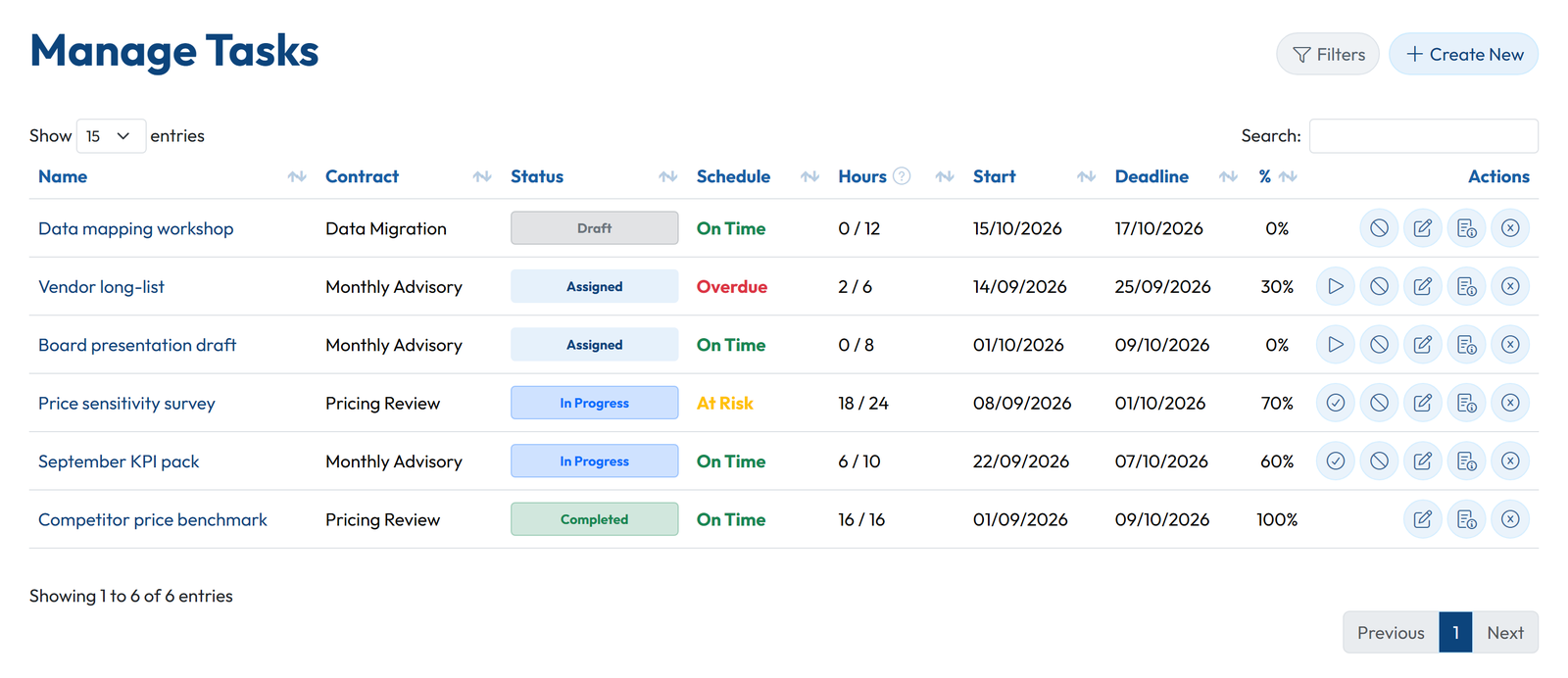
Tasks carry the early warning: estimated hours, hours recorded, percentage complete and a schedule indicator (On Time, At Risk or Overdue). Regular Users can update hours and progress but not dates, and every change to the contract's dates goes into its history with who and when: the record you show the client when you price a change request.
On T&M work, the client portal changes the tone of the monthly invoice: clients log in for free and see their tasks and the hours used against what was contracted, so the hours you bill are hours they watched being recorded. The billing schedule lists one line per billing period or milestone; you attach the invoice issued by your own invoicing software, and GoCons sends a reminder before each line is due and flags it when overdue. With Claude or ChatGPT connected through the GoCons MCP server (you sign in and click Allow, with no API keys), you can ask which tasks are At Risk in plain language.
The limits, plainly: GoCons does not issue invoices or take payments, has no built-in timer (hours are recorded on tasks) and no Gantt charts. It also gives you the history rule 3 needs: export every contract with its tasks to Excel, and you have your own ratio of actual to estimated hours.
Four questions before you try it on a live project
Do I need an implementation project? No. Create the account, add the contract you are pricing, invite the client.
Will my client need to pay or install anything? No. Client logins are free and unlimited, and they work in the browser.
What if I leave? On any plan, including Free, the Admin can download everything as one zip: Excel files for every contract, client and team member, plus all documents.
Is it priced per user? No, per consultancy. At the time of writing (October 2026), Free costs EUR 0 with up to 10 active contracts and 2 team users, Silver EUR 29 and Gold EUR 69 per month, excluding VAT; the pricing page has the current values.
Rebuilding this report every week? In GoCons your client follows tasks, milestones and hours as they change, so the report shrinks to the decisions you need. Free to start, no card needed.
FAQ
Is time and materials or fixed price better for the client?
It depends on how well the scope is known. A fixed price buys budget certainty at a premium; T&M is usually cheaper on average when the scope is uncertain, but the client has to watch the hours.
How much contingency should I add to a fixed price?
There is no universal percentage. Your break-even overrun equals your contingency, so set it from your own ratio of actual to estimated hours on similar projects, and add more where the client controls key inputs.
What is capped time and materials?
Time and materials with a maximum. Past the cap you finish at your own cost; if you finish early, the client pays only the hours used. Pair the cap with a re-baseline clause.
Can I switch from time and materials to fixed price mid-project?
Yes, and it is often the best path: run discovery on T&M, then sign a fixed-price statement of work for the remaining scope.
Price your next project with the numbers in view
Pick the model with the rule above, then watch the hours from the first week instead of the last. Add the contract you are pricing today, its tasks and their estimates, and invite the client to follow along. Create your free GoCons account.
References
- Acquisition.gov, "FAR 16.601 Time-and-materials contracts", https://www.acquisition.gov/far/16.601 (accessed October 2026).
- Acquisition.gov, "FAR 16.202-1 Firm-fixed-price contracts", https://www.acquisition.gov/far/16.202-1 (accessed October 2026).
- World Bank, "Procurement Regulations for IPF Borrowers, Seventh Edition, September 2025" (Annex VIII, Contract Types), https://thedocs.worldbank.org/en/doc/c84273d1b230aeb2b0b8134de5dc8cd7-0290012025/original/Procurement-Regulations-7th-Edition-Sep-2025.pdf (accessed October 2026).
- Government Digital Service (GOV.UK), "How to pay for Digital Outcomes and Specialists services" (guidance withdrawn on 31 December 2025), https://www.gov.uk/guidance/how-to-pay-for-digital-outcomes-and-specialists-services (accessed October 2026).
- Bent Flyvbjerg and Alexander Budzier, "Why Your IT Project May Be Riskier Than You Think", Harvard Business Review, Vol. 89, No. 9 (2011), preprint at https://arxiv.org/abs/1304.0265 (accessed October 2026).
© 2026 Mourinho Solutions. All rights reserved.